
It is, or should be, obvious to all of us that our nation is probably more polarized than at any point in our history since the Civil War. This is, in no small part, due to two factors. First, our two-party system has been increasingly unable to reach compromises on key issues that affect our every day lives.
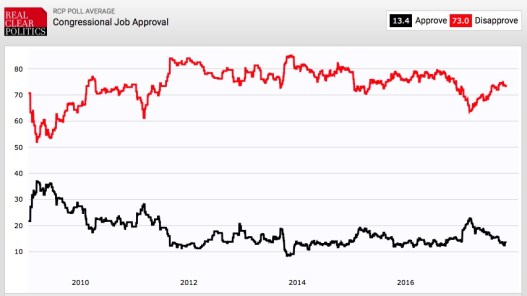
The below graphic from RealClearPolitics is a compilation of five universally respected public opinion polls. It clearly illustrates Americans’ dissatisfaction with the state of our legislative process. This dissatisfaction is not new. Congress’s job approval rating has been averaging between 10 and 20 percent for most of the past seven years. This certainly contributed to the populist uprising which lead to the election of Donald Trump in 2016. Other factors, such as the unevenness of the recovery from the Great Recession, contributed as well.
 Another contributing factor to the chasm in our two-party political system is the rejection of true journalism in favor of “opinion-based” news and social media. Why is it that real news facts that put the political right in a less-than-favorable light are rarely reported on by Fox News? There are examples on the left as well, albeit more on the fringe. And we are now learning that much of the deviseness that is fed by social media is the result of “fake news” planted by foreign operatives who want to whip our political discourse into the polarized frenzy it has become.
So what is the solution? First, our legislators must begin to introduce and deliberate on major legislation such as immigration, tax reform and health care based on its benefits to all our citizens, including the most vulnerable ones, and the impact on our nation’s financial health, and not on partisan talking points. However, the chances of open and honest dialog on the issues happening in our polarized two-party system are pretty low.
One approach to changing the paradigm may be to elect a new generation of independent thinkers who are not encumbered by the baggage of party politics and the special interests that seem to have corrupted our two-party system. We need to elect independent legislators who will introduce and consider legislation based on its merits to our citizens as a whole, and come up with real solutions for addressing our nation’s fiscal priorities in the process.
We might call this stakeholder-oriented legislation combined with fiscally responsible implementation strategies. It is not unlike how many corporations have reshaped their mission statements and strategies for sustained growth, while also placing an emphasis on social responsibility. What’s good for the private sector may be good for the public sector as well.
You may ask where I stand philosophically in the broad political spectrum of our times. I will say this; In my lifetime I have supported and voted an equal number of times for Republican and Democratic presidential candidates in the national election. I vote for the individual that best represents my values, and not along party lines.
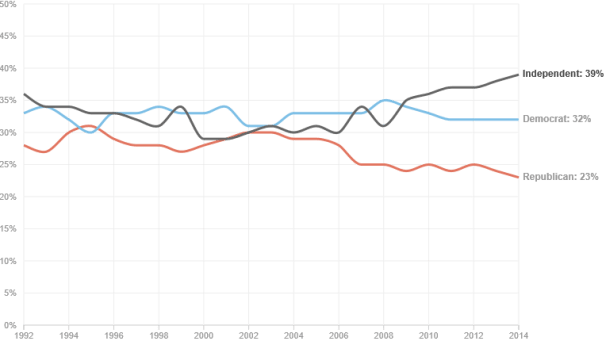
I am one of the 39 percent of Americans who identify as independent, compared with 32 percent who say they are Democrats and 23 percent who say they are Republicans, according to a 2014 analysis by the Pew Research Center. The below graphic illustrates how the increase of independent voters has evolved over the past 25 years. The percentage of millennials who identify as independent is even higher, at 48%.
This clearly suggests that independents can wield a lot of power at the voting booth, and that power is growing. Why not put that power to work, and nominate and elect free-thinking independents to local, state and national legislatures who will put the nation and its citizens first over party politics and special interests?
In the words of Franklin Roosevelt, the ultimate rulers of our democracy are the voters of this country.
% of Voters Who Identify With a Political Party or as Independent
 RichZacaroli.org