
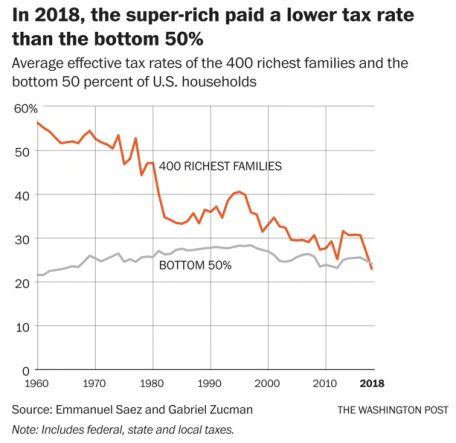
A recent study published by economists Emmanuel Saez and Gabriel Zucman of the University of California at Berkeley concluded that the 400 richest families in the U.S. paid a lower effective tax rate than the bottom 50% of taxpayers in the U.S.
While some economists are disputing some technicalities regarding calculations that might have a small impact on the result, the fact is that the effective tax rate paid by the richest Americans went down my more than half while the effective tax rate on the bottom 50% went up.
The super-rich saw the biggest tax cuts come during Ronald Reagan’s first term as president, Bill Clinton’s second term, and as a result of the tax legislation/reform passed in 2018. So this is not a partisan problem.
Among social benefits and services lost largely as a consequence of the tax cuts include education subsidies that kept tuitions at state colleges and universities very low until the mid-1980’s, and mental health facilities and care, which is considered to be one cause for the dramatic increase in homeless persons living on streets in major American cities.
It also points to a major issue with implementing a national health care or “medicare-for-all” system in the U.S. In addition to medical costs that are less than half of the U.S. per capita, effective tax rates in most industrialized countries, particularly on the wealthiest families and individuals, are 1.5 to 2 times higher than in the U.S.

 RichZacaroli.org