
There are many factors that will influence the 2018 mid-term elections. One factor is the new GOP Tax Bill, particularly as the impact begins to be felt by the many middle and upper-middle class taxpayers who are affected by it. My wife and I are empty nesters, and I have calculated that our federal income tax liability will increase by $800 to $1,000 per year beginning in 2018.
There are several features in the new tax bill that will negatively affect middle and upper-middle-class families. The most significant feature is the $10,000 limit on deductibility of state and local income and property taxes on our federal tax returns.
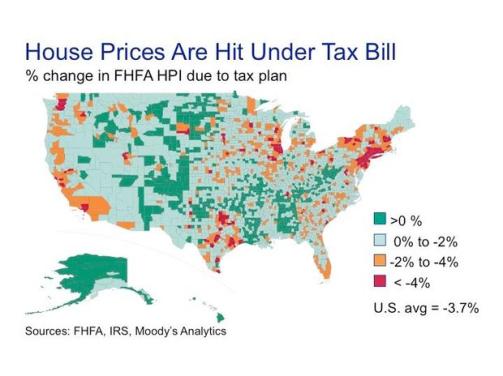
The below graphic compiled by Moody’s Analytics shows which areas of the country are expected to experience declining house prices due to the impact of the tax bill. They include the Northeast corridor, West Coast, and major metropolitan areas such as Chicago, Dallas-Ft. Worth, Houston, and their collar counties where the combination of state and local income and property taxes are the highest. But also note that there are many pockets in the upper-Midwest and Southeast U.S. that will also experience higher federal tax bills and may be expected to realize corresponding declines in housing prices.
Many of the areas described above that are adversely impacted voted for Trump in 2016. Many of these areas are home to middle-class voters who are currently represented by Republicans in Congress. Because income taxes are a highly personal matter, these Republican representatives can expect stiff competition in the 2018 mid-term elections.
The $10,000 limit on state and local income and property tax deductibility is a major factor. but there are other factors as well.
Families with three or more dependent children:
If you are a family of five or more, you may pay more taxes. The 2018 Standard Deduction for married couples has increased from $12,700 to $24,400. But the $4,050 exemption per person we enjoyed until 2017 are gone. So, instead of the standard deduction and four exemptions totaling $28,900 in 2017, a family of of six only have the standard deduction of $24,400 if they cannot itemize. The larger the family, the greater the impact. States with larger families such as Hawaii, and red states including Utah, Texas and Nevada will be particularly affected.
Additional deductions for individuals who are over 65 or blind are also gone.
Is there a silver lining?
Perhaps. If the corporate tax cut prompts new hiring and increases in compensation to workers, that may take away some of the anger. But that is not likely to happen in 2018. Most businesses that are on a January 1 to December 31 fiscal year,especially publicly held companies, have already cast their 2018 financial plans, staffing plans and operating budgets in stone. They will be very reluctant to make any changes at this point, and adopt a “wait and see” attitude before making major hiring and investment commitments, perhaps in 2019.
Bottom line; I believe the GOP tax bill could be a major factor in flipping the House in next November’s mid-term elections.

 RichZacaroli.org