
How THIS government shutdown could have easily been avoided

On that now infamous day nearly two weeks ago, a bipartisan group of senators presented to President Trump a DACA bill that would have protected the Dreamers and had broad bipartisan support in the Senate, and apparently the House as well. As we have now heard countless numbers of times, Trump rejected the bill with very harsh language [having to do with a hole or a house, we’re really not sure] because it did not do enough for border security (translate: it did not move us closer to the 2,200 mile wall Trump promised his base during the presidential campaign).

Since the Senate is confident that it has a large majority of bi-partisan support to pass the bill, as apparently does the House, and can potentially override a presidential veto should that happen, then why hasn’t the Republican leadership brought it to the floor for a vote? Had they done that, the Government would likely not have shut down because enough Senate Democrats would have supported a continuing resolution, to the extent that 60 votes would likely have been assured.

I suspect the Senate Democrats have done themselves no favor in the minds of American voters by keeping a continuing resolution from passing over the DACA issue and, thus, shutting down the government. While the majority of Americans support a permanent solution to DACA, the subject of immigration itself ranks very low in all polls on issues Americans consider to be national priorities. Only 5 to 10% of Americans consider immigration issues a priority, with the economy and jobs always at the top of every poll.

That said, by November countless new outrages by our president will have occupied our national discourse, and a government shutdown in early January will have long been forgotten.
How the new GOP Tax Bill could move us closer to a Democratic majority in the House in 2018

There are many factors that will influence the 2018 mid-term elections. One factor is the new GOP Tax Bill, particularly as the impact begins to be felt by the many middle and upper-middle class taxpayers who are affected by it. My wife and I are empty nesters, and I have calculated that our federal income tax liability will increase by $800 to $1,000 per year beginning in 2018.

There are several features in the new tax bill that will negatively affect middle and upper-middle-class families. The most significant feature is the $10,000 limit on deductibility of state and local income and property taxes on our federal tax returns.

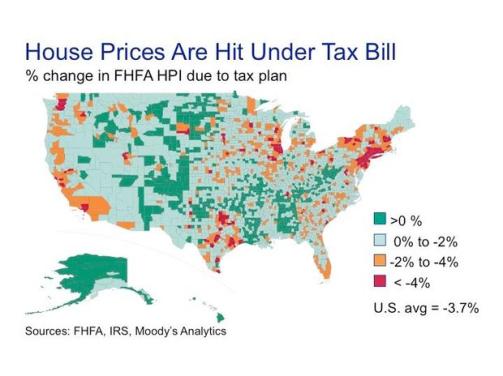
The below graphic compiled by Moody’s Analytics shows which areas of the country are expected to experience declining house prices due to the impact of the tax bill. They include the Northeast corridor, West Coast, and major metropolitan areas such as Chicago, Dallas-Ft. Worth, Houston, and their collar counties where the combination of state and local income and property taxes are the highest. But also note that there are many pockets in the upper-Midwest and Southeast U.S. that will also experience higher federal tax bills and may be expected to realize corresponding declines in housing prices.

Many of the areas described above that are adversely impacted voted for Trump in 2016.  Many of these areas are home to middle-class voters who are currently represented by Republicans in Congress. Because income taxes are a highly personal matter, these Republican representatives can expect stiff competition in the 2018 mid-term elections.

slide1

The $10,000 limit on state and local income and property tax deductibility is a major factor. but there are other factors as well.

Families with three or more dependent children:

If you are a family of five or more, you may pay more taxes. The 2018 Standard Deduction for married couples has increased from $12,700 to $24,400. But the $4,050 exemption per person we enjoyed until 2017 are gone. So, instead of the standard deduction and four exemptions totaling $28,900 in 2017, a family of of six only have the standard deduction of $24,400 if they cannot itemize. The larger the family, the greater the impact. States with larger families such as Hawaii, and red states including Utah, Texas and Nevada will be particularly affected.

Additional deductions for individuals who are over 65 or blind are also gone.

Is there a silver lining?

Perhaps. If the corporate tax cut prompts new hiring and increases in compensation to workers, that may take away some of the anger. But that is not likely to happen in 2018. Most businesses that are on a January 1 to December 31 fiscal year,especially publicly held companies, have already cast their 2018 financial plans, staffing plans and operating budgets in stone. They will be very reluctant to make any changes at this point, and adopt a “wait and see” attitude before making major hiring and investment commitments, perhaps in 2019.

Bottom line; I believe the GOP tax bill could be a major factor in flipping the House in next November’s mid-term elections.

Fox News – the cause behind America’s highly polarized politics… or is it?

Earlier this week, while appearing on the new Netflix series “My next guest needs no introduction with David Letterman”, Barack Obama probably summed it up best when Letterman asked Mr. Obama what he thinks is the most dangerous threat to a democracy.

“One of the biggest challenges we have to our democracy is the degree to which we don’t share a common baseline of facts,” Obama said. “If you watch Fox News, you are living on a different planet than you are if you are listening to NPR.”

It’s true. You don’t even need to watch Fox News. All you need to do is, and nearly any given time, compare the headlines on Fox News’ web site home page to any other news outlet. The 35% or so of Americans… which is not coincidentally the same percentage of Americans as Donald Trump’s base… who watch Fox News on a regular basis, and no other news channel, live in an alternate universe of “facts”.

Fox News isn’t even really about “news”. The New York Times may have said it best in an article last December titled “America’s New Religion: Fox Evangelicalism”. It is a hybrid kind of prostelitizing infotainment that interweaves conservative politics with conservative religious values and talking points that try to justify the occasionally outrageous things Donald Trump says or does based on religious grounds, and yet forgives him for his indiscretions at the same time.

So, the conclusion that those who are left of center might come to is that Fox News, and other lesser evangelizing conservative “news” outlets, are a major part of the problem. But is that entirely fair?

Recently on Jake Tapper’s CNN Sunday morning program, I was disturbed when Mr. Tapper abruptly ended an interview with Steven Miller, Trump’s senior advisor for policy, because Mr. Miller did not want discuss the latest Trump outrages that Mr. Tapper wanted to discuss. But what Mr. Miller was trying to say at the moment Tapper gave him the hook is that CNN does not give the people in the middle of the country who have lost their jobs and their homes, who are struggling to feed their children, the people who voted for Trump hoping for a savior, a voice. Nor do most major 24-7 news networks, frankly. They only have the “Fox Evangelical Channel” to turn to to hear a voice they think is sensitive to their problems. But really isn’t.